Storytellers in Focus: Inga Brege
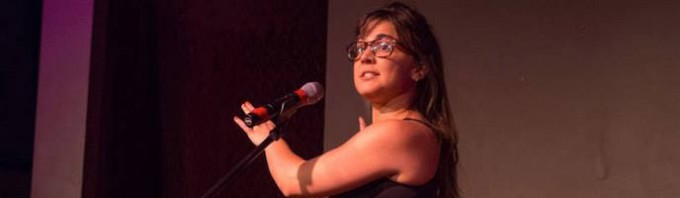
Inga Brege is a graphic designer and published researcher living in DC once again. A newcomer to the SpeakeasyDC community, she's made a splash performing twice already in her first year with us. This December she will be performing her first solo show Off Script about growing up and finding her voice amongst the colorful characters in her eccentric family
What brought you to SpeakeasyDC?
I grew up in University Park in a family of writers and performers and my big sister who is a director and writer had told me about storytelling when I was living in Los Angeles and said, “You know, you might have fun doing it”. When I moved back to DC, our family friend Michael Cotter, who is very involved with SpeakeasyDC, told me the same thing, so I decided to sign up for a boot camp class. I knew I didn't like stand-up stuff and I didn't like scripted things, but this seemed like something that fell in between. The first show I ever attended was a show I was in, so it was definitely a kind of “baptism by fire” thing. I had a lot of fun, but I had no idea it was such a well-functioning machine. I thought it was more, “Hey, let's get together in my friend's basement!”, so when I went to that performance I was like, “Oh no! There are people here! And this is like a really nice venue!” I think that's what scared me a little the first time, but as I started getting more involved, I mean, it is a thing! It's huge!
What was taking the storytelling boot camp course like?
It was a really cool experience. I grew up around theater but I actually can not stand theater people. I was kind of expecting to be taking the class with the kind of performers that are always sort of auditioning. I was afraid I would have to be like, “I'm not an agent! You can just be yourself with me!”. It wasn't like that at all. The class was much more intimate and honest than that “I'm breakin' into the biz!” attitude which I feel like improv classes and things like that can be, so right away I realized there was something special and different about SpeakeasyDC. I was also surprised at how hard storytelling is. I think everybody has experiences of going to a party and telling a funny story. You're thinking, “Yeah, I'm great with this!”, but during the class you realize, “Oh god the character has to change and grow? What's my personal growth been?”. All of the sudden you're in this much deeper place than you initially thought when you were going to tell a story about farts!
Tell us about your experience as a live storyteller.
I've only done two live shows. The first one was a gender gaps theme and I told a story about misunderstanding the term “gang banger” and everything that transpired from that. I just remember thinking, “Is my dad going to see this online if you search the term “gang banger”? Is it going to be like: Inga!”. I had a lot of fun even though I was extremely nervous. I don't know if I get the yips or something when I go in front of a group of people, but the whole SpeakeasyDC community was so cool and supportive. After the gender gaps show I was approached by someone who was asked if I had thought about doing a solo show, and I said, “This is the first eight minutes I've spent onstage...I don't know what that would mean!”. I ended up applying and got selected, so I'm really excited and terrified. I like that the SpeakeasyDC shows have an audience who aren't interested in being entertained necessarily, they're interested in being moved. People want to feel connected, so I have to deliver a story that achieves that.
How are you preparing for the solo show?
It's been cool working with Keith and Stephanie. You learn so much about people that you didn't know at all, like I know so much about Keith now. I know everything about these incredible tense periods of his life and I think he knows a lot more about me now too. There are always things that I think are so dull or so stupid in my story but when I go through it with them, they will be like, “Wait! That's so weird, your family does what?”, and I realize, “Oh, everyone's family doesn't do that?”. The whole process has been very helpful for figuring out what our stories are. You know that Hemingway quote where he's like, “Writing is easy, you just sit at the typewriter and bleed”? That is not an exaggeration. It's a lot of crying, not even that my show is sad or anything, I'm just pushing myself a lot harder. It's not like I didn't know this would take a lot of effort, but there's so much more introspection required than I originally thought. It's not just making a good product, it's more like becoming a good person and knowing yourself. I'm just rounding the corner to what will be one of the best experiences of my entire life. It's kind of what I imagine boot camp was like, where you feel like you are dying, but somewhere along the line you realize that you're so much stronger than you ever thought you could be!
What are your plans after the solo show?
I don't know, I guess we'll see how it goes. If it goes badly I'll move to another country and I'll never talk to anybody again! … Really though, I think SpeakeasyDC is such a cool organization that I'll always stay involved with if nothing else than a spectator and audience member. I mean, it is a craft so I guess it's like discovering if I am good at portraiture. If I am then maybe I'll keep doing this, if I'm not, I'll do the world a favor and stop doing this. However, I love writing, and I could see taking another Speakeasy course just because the community is such a cool group of people. The experience has made me feel like everyone is kind of finding their own niche with SpeakeasyDC and no matter what you're story is, people can kind of encourage and curate and it becomes something greater than what you thought was originally there.
Any advice for aspiring storytellers?
First of all it's awesome because anybody can do it. Probably the biggest hurdle for people who like performing as being “funny” is working to get past that urge to examine their story more closely. Everyone feels like they have the best joke, but people trying to be funny onstage is the most patronizing thing. It's almost like when you're out and someone is trying to pick you up and being like “Can you believe I'm talking to you? I'm incredible!”, and you're really wish they would immediately shut up. That's one of the harder things to get over. I struggled with that because I felt like I knew these funny bits on stuff, but nobody cares about a bit. You have to be honest to the story and not try to phone it in from somewhere else. I need to find out what I, Inga, am like. The biggest thing is being willing to dig deeper than, say, you would necessarily think with entertainment, but it is totally worth the risk and the difficulty. That's what storytelling is about. If you can be okay running around in your underwear and living your worst nightmare, you'll be an excellent storyteller.









Mobile Comments area